

F1 Express > Forums
Sports mécaniques online
Bush dans la merde...
Modérateurs: Garion, Silverwitch
 de sccc le 13 Avr 2006, 13:25
schumi84f1 a écrit:la France aurait aidé l'Irak à cacher des ADM
Ben oui, tu savais pas?
Il paraît en plus que vous en avez vendu à Saddam pendant la période des sanctions.
scc
THE ITALIAN GUY...
"...elles donnent beaucoup de lait vos chèvres mon brave? Les blanches donnent beaucoup de lait...et les noirrres aussi..."
THE ITALIAN GUY...
"...elles donnent beaucoup de lait vos chèvres mon brave? Les blanches donnent beaucoup de lait...et les noirrres aussi..."
-

sccc - Messages: 20255
- Inscription: 22 Fév 2003, 19:32
- Localisation: Belgique
de schumi84f1 le 13 Avr 2006, 13:27
sccc a écrit:schumi84f1 a écrit:la France aurait aidé l'Irak à cacher des ADM
Ben oui, tu savais pas?
Il paraît en plus que vous en avez vendu à Saddam pendant la période des sanctions.
c'est la gauche qui a vendu


designed by BWT ©
-

schumi84f1 - vettel84f1
- Messages: 37024
- Inscription: 12 Oct 2004, 20:39
- Localisation: APT (84)

de Hugues le 29 Avr 2006, 12:15
Le gouvernement fédéral américain est en train d'invoquer dans le procès des écoutes autorisées par l'administration Bush, dont l'EFF (Electronic Frontier Foundation, équivalent privé de la CNIL aux USA) est partie civile, une loi vestige de la Common Law britannique qui leur permet d'évoquer la raison d'état pour écarter les accusations et demander un non-lieu. Cette loi permet de demander d'annuler une affaire judiciaire si elle pourrait révéler des informations mettant la sécurité nationale en jeu.
Plus d'information:
http://wiredblogs.tripod.com/27BStroke6 ... id=1468765
Hugues
Plus d'information:
http://wiredblogs.tripod.com/27BStroke6 ... id=1468765
Hugues
- Hugues
de Hugues le 03 Juil 2006, 12:23
On a appris ces dernières heures que les écoutes de la NSA n'ont pas débuté après le 11 septembre 2001.
Mais que l'Administration Bush et la NSA les avaient entrepris au moins 7 mois avant cette date...
Autrement dit, à peine un mois après avoir pris ses fonctions, Bush demandait qu'on espionne la nation qui lui avait donné sa confiance.
Hugues
Mais que l'Administration Bush et la NSA les avaient entrepris au moins 7 mois avant cette date...
Autrement dit, à peine un mois après avoir pris ses fonctions, Bush demandait qu'on espionne la nation qui lui avait donné sa confiance.
Bloomberg a écrit:Spy Agency Sought U.S. Call Records Before 9/11, Lawyers Say
June 30 (Bloomberg) -- The U.S. National Security Agency asked AT&T Inc. to help it set up a domestic call monitoring site seven months before the Sept. 11, 2001 attacks, lawyers claimed June 23 in court papers filed in New York federal court.
The allegation is part of a court filing adding AT&T, the nation's largest telephone company, as a defendant in a breach of privacy case filed earlier this month on behalf of Verizon Communications Inc. and BellSouth Corp. customers. The suit alleges that the three carriers, the NSA and President George W. Bush violated the Telecommunications Act of 1934 and the U.S. Constitution, and seeks money damages.
``The Bush Administration asserted this became necessary after 9/11,'' plaintiff's lawyer Carl Mayer said in a telephone interview. ``This undermines that assertion.''
The lawsuit is related to an alleged NSA program to record and store data on calls placed by subscribers. More than 30 suits have been filed over claims that the carriers, the three biggest U.S. telephone companies, violated the privacy rights of their customers by cooperating with the NSA in an effort to track alleged terrorists.
``The U.S. Department of Justice has stated that AT&T may neither confirm nor deny AT&T's participation in the alleged NSA program because doing so would cause `exceptionally grave harm to national security' and would violate both civil and criminal statutes,'' AT&T spokesman Dave Pacholczyk said in an e-mail.
U.S. Department of Justice spokesman Charles Miller and NSA spokesman Don Weber declined to comment.
Pioneer Groundbreaker
The NSA initiative, code-named ``Pioneer Groundbreaker,'' asked AT&T unit AT&T Solutions to build exclusively for NSA use a network operations center which duplicated AT&T's Bedminster, New Jersey facility, the court papers claimed. That plan was abandoned in favor of the NSA acquiring the monitoring technology itself, plaintiffs' lawyers Bruce Afran said.
The NSA says on its Web site that in June 2000, the agency was seeking bids for a project to ``modernize and improve its information technology infrastructure.'' The plan, which included the privatization of its ``non-mission related'' systems support, was said to be part of Project Groundbreaker.
Mayer said the Pioneer project is ``a different component'' of that initiative.
Mayer and Afran said an unnamed former employee of the AT&T unit provided them with evidence that the NSA approached the carrier with the proposed plan. Afran said he has seen the worker's log book and independently confirmed the source's participation in the project. He declined to identify the employee.
Stop Suit
On June 9, U.S. District Court Judge P. Kevin Castel in New York stopped the lawsuit from moving forward while the Federal Judicial Panel on Multidistrict Litigation in Washington rules on a U.S. request to assign all related telephone records lawsuits to a single judge.
Robert Varettoni, a spokesman for Verizon, said he was unaware of the allegations against AT&T and declined to comment.
Earlier this week, he issued a statement on behalf of the company that Verizon had not been asked by the NSA to provide customer phone records from either its hard-wired or wireless networks. Verizon also said that it couldn't confirm or deny ``whether it has any relationship to the classified NSA program.''
Mayer's lawsuit was filed following a May 11 USA Today report that the U.S. government was using the NSA to monitor domestic telephone calls. Earlier today, USA Today said it couldn't confirm its contention that BellSouth or Verizon had contracts with the NSA to provide a database of domestic customer phone call records.
Jeff Battcher, a spokesman for Atlanta-based BellSouth, said that vindicated the company.
``We never turned over any records to the NSA,'' he said in a telephone interview. ``We've been clear all along that they've never contacted us. Nobody in our company has ever had any contact with the NSA.''
The case is McMurray v. Verizon Communications Inc., 06cv3650, in the Southern District of New York.
Hugues
- Hugues
de B.Verkiler le 03 Juil 2006, 12:34
Hugues a écrit:On a appris ces dernières heures que les écoutes de la NSA n'ont pas débuté après le 11 septembre 2001.
Mais que l'Administration Bush et la NSA les avaient entrepris au moins 7 mois avant cette date...
Autrement dit, à peine un mois après avoir pris ses fonctions, Bush demandait qu'on espionne la nation qui lui avait donné sa confiance.
Et il n'y a pas que ça qui était prévu avant le 11/09. Ca fait partie d'un package.
- B.Verkiler
- Messages: 33066
- Inscription: 26 Fév 2003, 14:19
de von Rauffenstein le 03 Juil 2006, 12:52
Pas oublier le Majestic Twelve les gârs ! C'est la faute aux p'tits gris de Roswell tout ça
http://www.mj12.com/
http://www.mj12.com/
Le fascisme au fait, c'était pas déjà l'histoire d'un mec en marche qui fascinait les foules avec son culte de la personnalité ?
-

von Rauffenstein - ultima ratio regum
- Messages: 46968
- Inscription: 20 Fév 2003, 18:01
- Localisation: Auteuil
de B.Verkiler le 03 Juil 2006, 12:54
von Rauffenstein a écrit:Pas oublier le Majestic Twelve les gârs ! C'est la faute aux p'tits gris de Roswell tout ça
http://www.mj12.com/
Les petits gris n'ont rien à voir là-dedans. Je suis sur qu'au moment de la première frappe sur la Chine, tu trouveras encore le moyen de penser que c'est en riposte à un bol de riz cantonnais frelaté trouvé à Chinatown.
- B.Verkiler
- Messages: 33066
- Inscription: 26 Fév 2003, 14:19
de von Rauffenstein le 03 Juil 2006, 12:56
'tain sérieux bévé ! C'est les p'tits gris tout ça !B.Verkiler a écrit:von Rauffenstein a écrit:Pas oublier le Majestic Twelve les gârs ! C'est la faute aux p'tits gris de Roswell tout ça
http://www.mj12.com/
Les petits gris n'ont rien à voir là-dedans. Je suis sur qu'au moment de la première frappe sur la Chine, tu trouveras encore le moyen de penser que c'est en riposte à un bol de riz cantonnais frelaté trouvé à Chinatown.
Le fascisme au fait, c'était pas déjà l'histoire d'un mec en marche qui fascinait les foules avec son culte de la personnalité ?
-
von Rauffenstein - ultima ratio regum
- Messages: 46968
- Inscription: 20 Fév 2003, 18:01
- Localisation: Auteuil
de B.Verkiler le 03 Juil 2006, 15:08
von Rauffenstein a écrit:'tain sérieux bévé ! C'est les p'tits gris tout ça !B.Verkiler a écrit:von Rauffenstein a écrit:Pas oublier le Majestic Twelve les gârs ! C'est la faute aux p'tits gris de Roswell tout ça
http://www.mj12.com/
Les petits gris n'ont rien à voir là-dedans. Je suis sur qu'au moment de la première frappe sur la Chine, tu trouveras encore le moyen de penser que c'est en riposte à un bol de riz cantonnais frelaté trouvé à Chinatown.
L'ironie c'est qu'à force de jouer les gros bras, les yankees font de moins en moins peur. Les chinois, mais aussi les russes, les sud-américains, tous ceux-là les envoient de plus en plus ouvertement chier. Ca sent les gesticulations de fin de vie pour les anglo-saxons. Ils vont s'écrouler comme des merdes. Nous autres européens, nous serions bien inspirés d'arrêter trés vite de leur lecher le cul, faute de quoi on va avoir une mauvaise surprise quand ils s'affaisseront.
- B.Verkiler
- Messages: 33066
- Inscription: 26 Fév 2003, 14:19
de von Rauffenstein le 03 Juil 2006, 15:12
B.Verkiler a écrit:von Rauffenstein a écrit:'tain sérieux bévé ! C'est les p'tits gris tout ça !B.Verkiler a écrit:von Rauffenstein a écrit:Pas oublier le Majestic Twelve les gârs ! C'est la faute aux p'tits gris de Roswell tout ça
http://www.mj12.com/
Les petits gris n'ont rien à voir là-dedans. Je suis sur qu'au moment de la première frappe sur la Chine, tu trouveras encore le moyen de penser que c'est en riposte à un bol de riz cantonnais frelaté trouvé à Chinatown.
L'ironie c'est qu'à force de jouer les gros bras, les yankees font de moins en moins peur. Les chinois, mais aussi les russes, les sud-américains, tous ceux-là les envoient de plus en plus ouvertement chier. Ca sent les gesticulations de fin de vie pour les anglo-saxons. Ils vont s'écrouler comme des merdes. Nous autres européens, nous serions bien inspirés d'arrêter trés vite de leur lecher le cul, faute de quoi on va avoir une mauvaise surprise quand ils s'affaisseront.
http://www.tk421.net/gallery/sounds/percep.wav
Le fascisme au fait, c'était pas déjà l'histoire d'un mec en marche qui fascinait les foules avec son culte de la personnalité ?
-
von Rauffenstein - ultima ratio regum
- Messages: 46968
- Inscription: 20 Fév 2003, 18:01
- Localisation: Auteuil
de B.Verkiler le 03 Juil 2006, 15:14
Tu ne sais pas mener une discussion géo-stratégique sérieuse, Panzer. .
- B.Verkiler
- Messages: 33066
- Inscription: 26 Fév 2003, 14:19
de von Rauffenstein le 03 Juil 2006, 15:18
Ceci dit, le bouquin d'Emanuel Todt "Après l'Empire", (je crois) est très intéressant. Mais je conseille aussi la lecture parrallèle de "Psychanalyse des Contes de Fées" de Bruno Betheleim.B.Verkiler a écrit:Tu ne sais pas mener une discussion géo-stratégique sérieuse, Panzer. .
Le fascisme au fait, c'était pas déjà l'histoire d'un mec en marche qui fascinait les foules avec son culte de la personnalité ?
-
von Rauffenstein - ultima ratio regum
- Messages: 46968
- Inscription: 20 Fév 2003, 18:01
- Localisation: Auteuil
de B.Verkiler le 03 Juil 2006, 18:07
von Rauffenstein a écrit: Mais je conseille aussi la lecture parrallèle de "Psychanalyse des Contes de Fées" de Bruno Betheleim.
Oui, ça doit être trés intéressant. Mais j'ai un peu peur que çe soit hors-sujet.
- B.Verkiler
- Messages: 33066
- Inscription: 26 Fév 2003, 14:19
de von Rauffenstein le 03 Juil 2006, 18:17
La psychanalyse ? Ou le conte de fée ?B.Verkiler a écrit:von Rauffenstein a écrit: Mais je conseille aussi la lecture parrallèle de "Psychanalyse des Contes de Fées" de Bruno Betheleim.
Oui, ça doit être trés intéressant. Mais j'ai un peu peur que çe soit hors-sujet.
Le fascisme au fait, c'était pas déjà l'histoire d'un mec en marche qui fascinait les foules avec son culte de la personnalité ?
-
von Rauffenstein - ultima ratio regum
- Messages: 46968
- Inscription: 20 Fév 2003, 18:01
- Localisation: Auteuil
de B.Verkiler le 03 Juil 2006, 18:20
von Rauffenstein a écrit:La psychanalyse ? Ou le conte de fée ?B.Verkiler a écrit:von Rauffenstein a écrit: Mais je conseille aussi la lecture parrallèle de "Psychanalyse des Contes de Fées" de Bruno Betheleim.
Oui, ça doit être trés intéressant. Mais j'ai un peu peur que çe soit hors-sujet.
Les deux.
- B.Verkiler
- Messages: 33066
- Inscription: 26 Fév 2003, 14:19
de von Rauffenstein le 03 Juil 2006, 18:25
Balance moi don' ce surmoi incongru aux orties.B.Verkiler a écrit:von Rauffenstein a écrit:La psychanalyse ? Ou le conte de fée ?B.Verkiler a écrit:von Rauffenstein a écrit: Mais je conseille aussi la lecture parrallèle de "Psychanalyse des Contes de Fées" de Bruno Betheleim.
Oui, ça doit être trés intéressant. Mais j'ai un peu peur que çe soit hors-sujet.
Les deux.
Le fascisme au fait, c'était pas déjà l'histoire d'un mec en marche qui fascinait les foules avec son culte de la personnalité ?
-
von Rauffenstein - ultima ratio regum
- Messages: 46968
- Inscription: 20 Fév 2003, 18:01
- Localisation: Auteuil
de B.Verkiler le 03 Juil 2006, 18:28
von Rauffenstein a écrit:Balance moi don' ce surmoi incongru aux orties.B.Verkiler a écrit:von Rauffenstein a écrit:La psychanalyse ? Ou le conte de fée ?B.Verkiler a écrit:von Rauffenstein a écrit: Mais je conseille aussi la lecture parrallèle de "Psychanalyse des Contes de Fées" de Bruno Betheleim.
Oui, ça doit être trés intéressant. Mais j'ai un peu peur que çe soit hors-sujet.
Les deux.
La psychanalyse, on a vu ce que ça donne quand tu te laches avec sur Starwars, hein.
- B.Verkiler
- Messages: 33066
- Inscription: 26 Fév 2003, 14:19
de von Rauffenstein le 03 Juil 2006, 18:36
hmmm ? Pour SW, il faut s'adresser au spécialiste. Et c'est pas moi qui fait des yoda en origami pour se le foutre au bout de la bite.B.Verkiler a écrit:von Rauffenstein a écrit:Balance moi don' ce surmoi incongru aux orties.B.Verkiler a écrit:von Rauffenstein a écrit:La psychanalyse ? Ou le conte de fée ?B.Verkiler a écrit:von Rauffenstein a écrit: Mais je conseille aussi la lecture parrallèle de "Psychanalyse des Contes de Fées" de Bruno Betheleim.
Oui, ça doit être trés intéressant. Mais j'ai un peu peur que çe soit hors-sujet.
Les deux.
La psychanalyse, on a vu ce que ça donne quand tu te laches avec sur Starwars, hein.
Le fascisme au fait, c'était pas déjà l'histoire d'un mec en marche qui fascinait les foules avec son culte de la personnalité ?
-
von Rauffenstein - ultima ratio regum
- Messages: 46968
- Inscription: 20 Fév 2003, 18:01
- Localisation: Auteuil
de B.Verkiler le 04 Juil 2006, 16:38
Et sinon, à part ta psychanlyse, une explication à ce drôle de phénomène qui consiste à mettre les citoyens sur écoute à grande échelle en vue de lutter contre le terrorisme (je suppose que c'est pour ça, quoi d'autre dans le pays des libertés ?) et ce alors même que le gouvernement américain n'a pas encore pris conscience du risque terroriste, puisque le 11/09 qui leur ouvrira les yeux n'a pas encore eu lieu ?
- B.Verkiler
- Messages: 33066
- Inscription: 26 Fév 2003, 14:19
de von Rauffenstein le 04 Juil 2006, 17:05
t'es american citizen ? Et sinon, en France, t'en penses quoi de la sureté nationale qui n'est pas censée exister ?B.Verkiler a écrit:Et sinon, à part ta psychanlyse, une explication à ce drôle de phénomène qui consiste à mettre les citoyens sur écoute à grande échelle en vue de lutter contre le terrorisme (je suppose que c'est pour ça, quoi d'autre dans le pays des libertés ?) et ce alors même que le gouvernement américain n'a pas encore pris conscience du risque terroriste, puisque le 11/09 qui leur ouvrira les yeux n'a pas encore eu lieu ?
Le fascisme au fait, c'était pas déjà l'histoire d'un mec en marche qui fascinait les foules avec son culte de la personnalité ?
-
von Rauffenstein - ultima ratio regum
- Messages: 46968
- Inscription: 20 Fév 2003, 18:01
- Localisation: Auteuil
de B.Verkiler le 04 Juil 2006, 17:11
von Rauffenstein a écrit:t'es american citizen ?B.Verkiler a écrit:Et sinon, à part ta psychanlyse, une explication à ce drôle de phénomène qui consiste à mettre les citoyens sur écoute à grande échelle en vue de lutter contre le terrorisme (je suppose que c'est pour ça, quoi d'autre dans le pays des libertés ?) et ce alors même que le gouvernement américain n'a pas encore pris conscience du risque terroriste, puisque le 11/09 qui leur ouvrira les yeux n'a pas encore eu lieu ?
Quel rapport ?
Et sinon, en France, t'en penses quoi de la sureté nationale qui n'est pas censée exister ?
Elle me protège des terroristes depuis le 11 septembre 2001. J'ai bon ?
- B.Verkiler
- Messages: 33066
- Inscription: 26 Fév 2003, 14:19
de von Rauffenstein le 04 Juil 2006, 17:11
Bin tu critiques qui tout l'temps ?B.Verkiler a écrit:von Rauffenstein a écrit:t'es american citizen ?B.Verkiler a écrit:Et sinon, à part ta psychanlyse, une explication à ce drôle de phénomène qui consiste à mettre les citoyens sur écoute à grande échelle en vue de lutter contre le terrorisme (je suppose que c'est pour ça, quoi d'autre dans le pays des libertés ?) et ce alors même que le gouvernement américain n'a pas encore pris conscience du risque terroriste, puisque le 11/09 qui leur ouvrira les yeux n'a pas encore eu lieu ?
Quel rapport ?
Bin ouais...Et sinon, en France, t'en penses quoi de la sureté nationale qui n'est pas censée exister ?
Elle me protège des terroristes depuis le 11 septembre 2001. J'ai bon ?
Le fascisme au fait, c'était pas déjà l'histoire d'un mec en marche qui fascinait les foules avec son culte de la personnalité ?
-
von Rauffenstein - ultima ratio regum
- Messages: 46968
- Inscription: 20 Fév 2003, 18:01
- Localisation: Auteuil
de B.Verkiler le 04 Juil 2006, 17:30
von Rauffenstein a écrit:Bin tu critiques qui tout l'temps ?B.Verkiler a écrit:von Rauffenstein a écrit:t'es american citizen ?B.Verkiler a écrit:Et sinon, à part ta psychanlyse, une explication à ce drôle de phénomène qui consiste à mettre les citoyens sur écoute à grande échelle en vue de lutter contre le terrorisme (je suppose que c'est pour ça, quoi d'autre dans le pays des libertés ?) et ce alors même que le gouvernement américain n'a pas encore pris conscience du risque terroriste, puisque le 11/09 qui leur ouvrira les yeux n'a pas encore eu lieu ?
Quel rapport ?
Probablement parce que je ne refuse pas de me poser les questions que toi tu refuses absolument de te poser. Alors je répète la question.
- B.Verkiler
- Messages: 33066
- Inscription: 26 Fév 2003, 14:19
de von Rauffenstein le 04 Juil 2006, 17:45
Mais sur le fond, on pourrait être bien d'accord. Simplement, les muzzies, y m'cassent les couilles gravos maint'nant. Stout. Qu'on les nuke et qu'y nous foutent la paix une bonne fois pour toute.B.Verkiler a écrit:von Rauffenstein a écrit:Bin tu critiques qui tout l'temps ?B.Verkiler a écrit:von Rauffenstein a écrit:t'es american citizen ?B.Verkiler a écrit:Et sinon, à part ta psychanlyse, une explication à ce drôle de phénomène qui consiste à mettre les citoyens sur écoute à grande échelle en vue de lutter contre le terrorisme (je suppose que c'est pour ça, quoi d'autre dans le pays des libertés ?) et ce alors même que le gouvernement américain n'a pas encore pris conscience du risque terroriste, puisque le 11/09 qui leur ouvrira les yeux n'a pas encore eu lieu ?
Quel rapport ?
Probablement parce que je ne refuse pas de me poser les questions que toi tu refuses absolument de te poser. Alors je répète la question.
Le fascisme au fait, c'était pas déjà l'histoire d'un mec en marche qui fascinait les foules avec son culte de la personnalité ?
-
von Rauffenstein - ultima ratio regum
- Messages: 46968
- Inscription: 20 Fév 2003, 18:01
- Localisation: Auteuil
de sccc le 18 Aoû 2006, 20:33
Up!
Je dois faire amende honorable. J'ai toujours pensé que la démocratie en Irak avec la méthode Bush ça pouvait pas marcher, mais il y a clairement un mieux dans la situation de ce pays:
Saving the Iraqi Partridges
A rare piece of good news from Iraq: a once-endangered bird is making a big comeback
Posted Wednesday, Aug. 16, 2006
In the southwestern outskirts of Baghdad, not far from the airport, the presence of American soldiers has had at least one unexpected benefit. It has fostered the revival of a nearly extinct species of partridge.
The black partridge (francolinus francolinus) were almost hunted into extinction in the Saddam years by Iraqi sportsmen-hunters. But these days, that part of Baghdad is under U.S. military protection — it adjoins the largest military base in Iraq — and any Iraqi wielding a gun is liable to be tossed in jail on suspicion of being a terrorist. So no hunters dare go there, and the birds have made a strong comeback.
Local farmers in the area say partridge sightings, once rare, have become commonplace. One farmer told TIME his farm is being overrun by the birds. He'd like nothing better than to shoot a few — they make delicious eating, he says. But he worries that the gunshots may be overheard by the Americans. So the grouse swagger around unharmed. "They come right up to my door," he says. "It's as if they know they are untouchable."
North of Baghdad, near Saddam's hometown of Tikrit, the presence of American troops has led to a similar revival of another species once popular with Iraqi hunters: the sand grouse. The two bird species are featured in Iraqi postage stamps in the pre-Saddam era.
Hunting was a favorite pastime in pre-war Iraq; most families own at least one weapon. Saddam and his sons were keen hunters, stocking the compounds of their palaces with game birds and hares. But some of the most popular hunting areas, south of the Iraqi capital along the banks of the Tigris and Eurphrates rivers, have become strongholds of insurgent and terrorist groups; few Baghdad residents dare venture there. Late last year, the owner of one of Baghdad's largest gun stores said many of his customers were exchanging their hunting rifles for AK-47s — the better to protect their homes.
scc
THE ITALIAN GUY...
"...elles donnent beaucoup de lait vos chèvres mon brave? Les blanches donnent beaucoup de lait...et les noirrres aussi..."
THE ITALIAN GUY...
"...elles donnent beaucoup de lait vos chèvres mon brave? Les blanches donnent beaucoup de lait...et les noirrres aussi..."
-
sccc - Messages: 20255
- Inscription: 22 Fév 2003, 19:32
- Localisation: Belgique


de Hugues le 29 Aoû 2006, 01:22
Vous vous souvenez tous je présume de Katherine Harris, Secrétaire d'Etat (State Secretary) de la Floride à l'époque, chargée donc superviser et de valider ou non la légitimité du vote ou de demander la poursuite des recomptages... Et pro-Bush, bien qu'elle s'en défendait à l'époque, tant et si bien qu'elle fut élue en 2002 pour le Parti Républicain à la Chambre des Représentants et qu'elle brigue le poste de sénateur toujours pour le Parti Républicain pour les prochaines élections de mi-mandat (mid-term).
Elle s'est fendue d'une entrevue récemment sur le Florida Baptist Witness, publication d'une remarquable neutralité vous en conviendrez ..
Sans doute, quelque peu déconcerté qu'une personne brigant un poste politique se laisse aller ainsi à évoquer ses convictions religieuses, vous dites vous que heureusement, elle est consciente de la séparation de l'Eglise et l'Etat et ne mélange pas ses convictions avec son action en tant que politique, ou que Secrétaire d'Etat par le passé.. Ce n'est pas certain...
Le reste de l'entrevue est du même tonneau ...
http://www.floridabaptistwitness.com/6298.article
Trois réactions à cette entrevue sur un site commentant cette entrevue m'ont paru intéressantes:
A noter que cette dame a connu quelques ennuis liés à des malversations financières.. D'une part alors qu'elle était secrétaire d'Etat, ses dépenses pour voyage durant ses 22 mois au poste, se sont élevés à 106000 dollars, plus que tout membre de cabinet ou plus que le Gouverneur, elle a visité ainsi 8 pays durant 10 voyages.
Elle avait requis fin 2000 qu'un budget de 3,4 millions de dollars lpour les relations internationales, juste pour la seule année 2001. Début 2001, les leaders du Senat de Floride ont éliminé ces 3,4 millions, les assignant à l'agence de développement économique de l'Etat, Enterprise Florida. Mais le leader de la Chambre a exprimé son désaccord avec le Sénat expliquant qu'elle était un avocat compétent auprès des autres pays. Après que la Chambre ait refusé la suppression de ce budget, le Sénat accepta de le lui réattribuer, mais insista qu'un comité, nommé par les Présidents du Sénat, le leader de la Chambre et le gouverneur Jeb Bush soit créé pour évaluer toutes ses dépenses.
En 2005-2006, elle a été mêlé à un scandale de financement de campagne par un contractant du Pentagone, MZM, ce qui est considéré comme de la corruption.. Le procureur a toutefois affirmé qu'elle même n'était pas au courant de l'illégalité de ces financements, au contraire des gens de MZM ou de membres de sa campagne.. Pourtant celle-ci avait été conviée à un diner avec le fondateur de MZM, diner pour le moins copieux étant donné la note de 2800 dollars..
Enfin, anecdotiquement plus étonnament, Jeb Bush, dont on pourrait croire qu'il est reconnaissant qu'elle ait penché en 2000 en la faveur de son frère, a questionné courant 2005 sa capacité à devenir Sénateur, incitant d'autres candidats à se présenter pour mener des primaires.
Hugues
Elle s'est fendue d'une entrevue récemment sur le Florida Baptist Witness, publication d'une remarquable neutralité vous en conviendrez
..
Some day all of us have to give an account before God for what we have done. Are you certain in your own heart that when you come to that point of accounting that you’ll spend eternity with God in Heaven?
No question.
One day when you stand before God, if He says to you, “Why should I let you into my Heaven?” What you would say in response?
That’s an interesting question. Because I loved Your Son and because I know He died for my sins. I know He was resurrected at Your right hand and I served Him. You know we’re covered with, our sins are covered with His blood and so we are blameless before Him. We are as white as snow.
Sans doute, quelque peu déconcerté qu'une personne brigant un poste politique se laisse aller ainsi à évoquer ses convictions religieuses, vous dites vous que heureusement, elle est consciente de la séparation de l'Eglise et l'Etat et ne mélange pas ses convictions avec son action en tant que politique, ou que Secrétaire d'Etat par le passé.. Ce n'est pas certain...
What role do you think people of faith should play in politics and government?
The Bible says we are to be salt and light. And salt and light means not just in the church and not just as a teacher or as a pastor or a banker or a lawyer, but in government and we have to have elected officials in government and we have to have the faithful in government and over time, that lie we have been told, the separation of church and state, people have internalized, thinking that they needed to avoid politics and that is so wrong because God is the one who chooses our rulers. And if we are the ones not actively involved in electing those godly men and women and if people aren’t involved in helping godly men in getting elected than we’re going to have a nation of secular laws. That’s not what our founding fathers intended and that’s certainly isn’t what God intended.
Le reste de l'entrevue est du même tonneau ...
http://www.floridabaptistwitness.com/6298.article
Trois réactions à cette entrevue sur un site commentant cette entrevue m'ont paru intéressantes:
"God is the one who chooses our rulers"
That's funny, I thought it was Katherine Harris and the Supreme Court who chose...
I think she's right. But she needs to just stop at "Separation of church and state is a lie." The rest of her speak is batshit lunacy. I think the Bush administration has made it quite clear that we are all to live by the morals and principles of the Holy Bible. Thank you George. I appreciate it when fascist rulers dictate what moral guiding principles their constituency should adhere to, because we're too dumb to think for ourselves.
I'm actually curious about the answer you would give to the following 3 questions.
1. What is freedom?
2. Is Christian Theology / Dogma / people agaist that version of freedom
3. If yes, What would freedom have to be and/or what would Christian Theology / Dogma / people be in order to be pro Freedom / pro Christian.
A noter que cette dame a connu quelques ennuis liés à des malversations financières.. D'une part alors qu'elle était secrétaire d'Etat, ses dépenses pour voyage durant ses 22 mois au poste, se sont élevés à 106000 dollars, plus que tout membre de cabinet ou plus que le Gouverneur, elle a visité ainsi 8 pays durant 10 voyages.
Elle avait requis fin 2000 qu'un budget de 3,4 millions de dollars lpour les relations internationales, juste pour la seule année 2001. Début 2001, les leaders du Senat de Floride ont éliminé ces 3,4 millions, les assignant à l'agence de développement économique de l'Etat, Enterprise Florida. Mais le leader de la Chambre a exprimé son désaccord avec le Sénat expliquant qu'elle était un avocat compétent auprès des autres pays. Après que la Chambre ait refusé la suppression de ce budget, le Sénat accepta de le lui réattribuer, mais insista qu'un comité, nommé par les Présidents du Sénat, le leader de la Chambre et le gouverneur Jeb Bush soit créé pour évaluer toutes ses dépenses.
En 2005-2006, elle a été mêlé à un scandale de financement de campagne par un contractant du Pentagone, MZM, ce qui est considéré comme de la corruption.. Le procureur a toutefois affirmé qu'elle même n'était pas au courant de l'illégalité de ces financements, au contraire des gens de MZM ou de membres de sa campagne.. Pourtant celle-ci avait été conviée à un diner avec le fondateur de MZM, diner pour le moins copieux étant donné la note de 2800 dollars..
Enfin, anecdotiquement plus étonnament, Jeb Bush, dont on pourrait croire qu'il est reconnaissant qu'elle ait penché en 2000 en la faveur de son frère, a questionné courant 2005 sa capacité à devenir Sénateur, incitant d'autres candidats à se présenter pour mener des primaires.
Hugues
- Hugues
de Hugues le 07 Sep 2006, 07:19
Le président Bush a avoué l'existence des prisons secrètes de la CIA. Si cet aveu est un pas positif, qu'une démocratie ait choisi, ce moyen digne de quelques régimes autoritaires ne fera que renforcer la crédibilité du discours islamiste qui décrit l'Occident comme injuste. Après les lois d'exception (iniques parce qu'ellese séparenr les Hommes en ceux qui ont des droits et ceux qui parce que soupçonné (peut-être à tort) de terrorisme, n'en ont pas.. ce n'est pas en étant injuste qu'une démocratie décrédibilise le discours islamiste), ces prisons d'exception sont une énième décision malheureuse, funeste de l'administration Bush fin 2001, qui sera sans doute plus préjudiciable à la nation américaine que de lui être bénéfique..
Certaines populations de par le monde retiendront en effet plus l'injustice d'avoir emprisonné des suspects dans ces conditions, que toute autre chose, et cela aidera au recrutement malheureusement.
Hugues
Certaines populations de par le monde retiendront en effet plus l'injustice d'avoir emprisonné des suspects dans ces conditions, que toute autre chose, et cela aidera au recrutement malheureusement.
Liberation a écrit:Bush reconnait l'existence de prisons secrètes de la CIA à l'étranger
Par F. Ro.
LIBERATION.FR : Mercredi 6 septembre 2006 - 20:39
7 réactions
avec
C'est une première. Jusque-là, George W Bush avait tout démenti. En bloc.
Mercredi soir, pourtant, pour la première fois, le président américain a reconnu que des étrangers soupçonnés de terrorisme avaient été détenus en dehors des Etats-Unis par des agents de la CIA.
Allant encore plus loin, à quelques jours du cinquième anniversaire du 11 septembre, Bush a même défendu ce programme de la CIA visant à interroger des suspects, estimant qu'il s'agissait d'une source capitale de renseignements.
«Notre sécurité dépend de notre faculté à obtenir ce genre de renseignements» a déclaré Bush.
Le programme de la CIA avait été révélé l'année dernière par le Washington Post, et avait soulevé un tollé international contre l'administration Bush, laquelle n'avait jamais reconnu officiellement l'existence de tels centres de détention secrets. Une enquête européenne avait démontré que certains des prisonniers interrogés par la CIA avaient transité par plusieurs villes européennes. Et l'existence de prisons secrètes dans l'ex bloc de l'Est avait été évoquée.
Le Figaro a écrit:Bush reconnaît l’existence des prisons secrètes de la CIA
lefigaro.fr (avec AFP, AP, Reuters).
Publié le 06 septembre 2006
Actualisé le 06 septembre 2006 : 20h45
Le président américain a justifié mercredi soir le «programme» des prisons secrètes par les nécessités de la «guerre contre le terrorisme». 14 prisonniers détenus par la CIA ont été transférés à Guantanamo dans l’attente de leur jugement. Parmi eux, Khalid Cheik Mohammed, le «cerveau» des attentats du 11 septembre.
Changement de cap. Lors d’un discours mercredi devant plusieurs familles de victimes des attentats du 11 septembre, George Bush a annoncé plusieurs modifications majeures de sa politique concernant les prisonniers capturés dans le cadre de la «guerre contre le terrorisme».
Pour la première fois, le président américain a reconnu que certains suspects ont été détenus et interrogés à l’étranger par la CIA. L’information, révélée par la presse américaine, était jusqu’ici niée par la Maison Blanche. Bush a justifié ce «programme», réservé à «un petit nombre» de détenus de valeur, expliquant qu’«il a été nécessaire de déplacer ces individus dans un environnement où ils pouvaient être tenus au secret, interrogés par des spécialistes et, le cas échéant, poursuivi pour leurs actes terroristes ».
A l’appui, il a cité des cas où les aveux d’un terroriste présumé avaient permis d’empêcher un attentat. Quatorze de ces prisonniers, parmi lesquels Khalid Cheik Mohammed, le «cerveau» des attentats du 11 septembre, «affronteront» la justice. Ils ont été transférés à la prison de Guantanamo dans l’attente de leur procès, devant des «tribunaux militaires».
Le Pentagone appliquera la Convention de Genève pour les prisonniers soupçonnés de terrorisme
George Bush a également martelé que les Etats-Unis «ne pratiquaient pas la torture et ne la pratiqueraient jamais». Plus tôt dans la journée, le Pentagone avait annoncé qu’il appliquerait désormais l’article 3 de la Convention de Genève. Ce texte proscrit toute torture ou mauvais traitement à l’égard d’un prisonnier. «Tous les détenus devront être traités humainement et en accord avec les lois américaines, les lois de la guerre», affirme la directive, signée par le numéro deux du Pentagone, Gordon England.
Cette décision constitue un changement majeur de la politique appliquée depuis 2002. George Bush avait alors qualifié les membres d’al-Qaida et autres détenus soupçonnés de terrorisme d’ «combattants ennemis» ne bénéficiant pas de la protection de la Convention de Genève. Toutefois, comme l’a précisé le ministère américain de la Défense, la nouvelle directive ne s'applique qu’aux prisonniers sous la responsabilité du Pentagone. En clair, elle ne concerne pas les détenus interrogés par des agents de la CIA à l'étranger.
New York Times a écrit:President Moves 14 Held in Secret to Guantánamo
David Scull for The New York Times
President Bush urged Congress to pass legislation that would authorize new military commissions to put terrorism suspects on trial, to replace rules struck down by the Supreme Court.
By SHERYL GAY STOLBERG
Published: September 7, 2006
WASHINGTON, Sept. 6 — President Bush said Wednesday that 14 high-profile terror suspects held secretly until now by the Central Intelligence Agency — including the man accused of masterminding the Sept. 11 attacks — had been transferred to the detention center at Guantánamo Bay, Cuba, to face military tribunals if Congress approves.
The suspects include Khalid Shaikh Mohammed, thought to be the Sept. 11 mastermind, and other close associates of Osama bin Laden. Mr. Bush said he had decided to “bring them into the open” after years in which the C.I.A. held them without charges in undisclosed sites abroad, in a program the White House had not previously acknowledged.
The announcement, in the East Room of the White House, was the first time the president had discussed the secret C.I.A. program, and he made clear that he had fully authorized it. Mr. Bush defended the treatment the suspects had received but would not say where the so-called “high-value terrorist detainees” had been held or what techniques had been used to extract information from them.
The transfer of the high-level suspects to Guantánamo Bay effectively suspended the extraordinary program, in which the intelligence agency became the jailer and interrogator of suspects counterterrorism officials considered the world’s most wanted Islamic extremists.
The government says the 14 terror suspects include some of the most senior members of Al Qaeda captured by the United States since 2001, including those responsible for the bombing of the destroyer Cole in 2000 in Yemen and the 1998 attacks on American embassies in Kenya and Tanzania. Most of the detainees have been interviewed extensively and are believed to have little remaining intelligence value.
With the transfer of the suspects to Guantánamo, which is run by the Defense Department, the International Committee of the Red Cross will monitor their treatment, Mr. Bush said. He used the East Room appearance to urge Congress to authorize new military commissions to put terror suspects on trial, replacing rules established by the administration but struck down in June by the Supreme Court. [Page A21.]
“As soon as Congress acts to authorize the military commissions I have proposed, the men our intelligence officials believe orchestrated the deaths of nearly 3,000 Americans on Sept. 11, 2001, can face justice,” Mr. Bush said, to an audience that included family members of the victims. He added, “To start the process for bringing them to trial, we must bring them out into the open.”
To that end, the president sent Congress legislation proposing new rules for the commissions and detailing specific standards for the humane treatment of detainees. Yet the proposal hews closely to the old commission model, and it retains several provisions the court found troublesome, including language that permits defendants to be excluded from their own trials.
At the same time, the Pentagon released a new Army Field Manual that lays out permissible interrogation techniques and specifically bans eight methods that have come up in abuse cases. Among the techniques banned is water-boarding, in which a wet rag is forced down a bound prisoner’s throat to cause gagging; intelligence officials have said Mr. Mohammed was subjected to that treatment while in C.I.A. custody.
Although the C.I.A. has faced criticism over the use of harsh techniques, one senior intelligence official said detainees had not been mistreated. They were given dental and vision care as well as the Koran, prayer rugs and clocks to schedule prayers, the official said. They were also given reading material, DVD’s and access to exercise equipment.
Administration officials said the timing of Mr. Bush’s decision to bring the terror suspects to trial was driven not by politics but by the need to respond to the Supreme Court’s decision and the fact that the suspects were no longer regarded as sources of valuable intelligence.
On Capitol Hill, some Republicans reacted warily. But even those who criticized the proposal said it was imperative for Congress to pass legislation setting up tribunals soon.
“I do not believe it is necessary to have a trial where the accused cannot see the evidence against them,” said Senator Lindsey Graham, Republican of South Carolina, a former military prosecutor who has played a central role in the debate. But Mr. Graham said he believed his differences with the White House “can be overcome.”
Mr. Bush’s speech was the third in a series he is delivering on the war on terror in the days before the fifth anniversary of the Sept. 11 attacks, and it carried potential political benefits for a White House that is intent on maintaining Republican control of Congress this November.
The address helped put a face on the enemy, reminding Americans that while Osama bin Laden — to whom Mr. Bush referred repeatedly in a speech on Tuesday — is still at large, many terrorists have been captured. Five years after the attacks, Mr. Bush gave the families of Sept. 11 victims something to cheer about, and those in the audience did, as he announced he wanted to put the suspects on trial.
By moving the high-profile suspects to Guantánamo just two months before the midterm elections, the administration is putting intense pressure on lawmakers to act before adjourning to campaign. If Democrats try to thwart legislation to try senior members of Al Qaeda, they will risk being labeled weak on national security, a label they can ill afford in an election that may turn on the question of which party is better suited to keep Americans safe.
“This is certainly a logical and very sound step both substantively and politically,” said David Rivkin, who served in the White House counsel’s office under the first President Bush and is sympathetic to this administration’s approach. “It’s reminding the country and the world of the folks we are fighting against. Nobody can say these are just pitiful foot soldiers; these are pretty senior guys.”
The C.I.A. program, though officially a secret, has been the subject of numerous news reports in recent months. By speaking publicly about it for the first time, Mr. Bush hopes to build support for it on Capitol Hill, and in the public.
The White House released biographies of the 14 suspects and details of the accusations against them. They include such well-known Qaeda operatives as Abu Zubaydah, who the administration said was trying to organize a terrorist attack in Israel at the time of his capture, and Ramzi bin al-Shibh, who the authorities say helped facilitate the Sept. 11 attacks.
Despite the new information, human rights organizations were critical of Mr. Bush’s announcement.
“It’s wonderful that at last the United States has acknowledged that these detention sites exist,” said Larry Cox, executive director of Amnesty International U.S.A. But Mr. Cox described the program as “a form of torture,” and said the United States should suspend it.
In his speech, Mr. Bush fiercely resisted that characterization. “I want to be absolutely clear with our people, and the world,” he said. “The United States does not torture. It’s against our laws, and it’s against our values. I have not authorized it — and I will not authorize it.”
A senior intelligence official said there had been fewer than 100 detainees in the C.I.A. program since its inception shortly after the Sept. 11 attacks. Beyond the 14, the remainder have either been turned over to the Defense Department as so-called unlawful enemy combatants, returned to their countries of origin or sent to nations that have legal proceedings against them.
The official described the C.I.A. detainees as the government’s “single largest source of insight into Al Qaeda,” saying they accounted for 50 percent of everything the authorities had learned about the terrorist network. But, he said, “Some of these people have been held for a considerable period of time, and their intelligence value has aged off.”
Mr. Bush said the C.I.A. would not relinquish its capability to detain and question terrorism suspects, and the senior intelligence official said the administration intended that the program would continue. But agency officials — who feared employees might be subject to lawsuits or criminal prosecution — welcomed the hand-off of the detainees and the prospect that the C.I.A.’s role would be limited in future cases.
“I am confident that this will be greeted with relief by agency employees,” said Jeffrey H. Smith, a former general counsel for the C.I.A. “Many of them were uncomfortable with their role as jailers.”
Military justice experts say that if Congress passes the legislation, trials of some terror suspects at Guantánamo could begin relatively quickly, in three to four months. But the trials of the 14 high-value suspects, who are held in a special high-security facility separate from other detainees, might not begin for at least a year, because the government would have to build its case .
One expert who has been critical of the administration’s plan, Eugene R. Fidell, predicted that the proposal would attract a lawsuit.
“Going the way they have done this is in fact quite unfair to the very families of 9/11 victims who President Bush had at his meeting today,” Mr. Fidell said, “because those people need closure and in fact what he’s done is guarantee further protracted delay because of the inevitable litigation.”
On Capitol Hill, Democrats were also critical. Representative Jane Harman of California, the senior Democrat on the House Intelligence Committee, said Mr. Bush should have disclosed the program years ago and called his speech “the opening salvo in the fall campaign.”
David Johnston and Mark Mazzetti contributed reporting for this article.
Washington Post a écrit:Bush Says Detainees Will Be Tried
He Confirms Existence of CIA Prisons
By R. Jeffrey Smith and Michael Fletcher
Washington Post Staff Writers
Thursday, September 7, 2006; A01
President Bush yesterday announced the transfer of the last 14 suspected terrorists held by the CIA at secret foreign prisons to the military detention facility at Guantanamo Bay, Cuba, and said he wants to try them before U.S. military panels under proposed new rules he simultaneously sent to Congress.
Bush's statement during an impassioned East Room speech represented the first time he has confirmed the existence of the CIA program under which Khalid Sheik Mohammed, the self-proclaimed mastermind of the Sept. 11, 2001, attacks, and others have been secretly held and subjected to irregular interrogation methods.
The president's dramatic speech committed Washington to putting senior al-Qaeda members -- including some believed to be the architects of the attacks -- on trial in proceedings that may be at least partly open. Only one person, Zacarias Moussaoui, has been convicted of conspiring in the attacks, and he had little to do with the actual plot.
Standing before an audience that included family members of attack victims, Bush delivered remarks timed to stake out a new policy position before the November elections -- and also to pressure lawmakers to approve quickly the administration's version of legislation on detainee matters that have been hotly debated for years.
Bush largely defended his administration's controversial detainee policies. But he spoke on the same day that the Defense Department, under pressure from Congress and the Supreme Court, separately ruled out the military's future use of interrogation methods that officials have said were practiced on the CIA's detainees -- including the use of temperature extremes and waterboarding, which simulates drowning.
Together with the emptying of the secret CIA sites, the imposition of the new interrogation rules amounted to a policy shift for the White House. The administration has come under substantial foreign and judicial criticism for insisting on the right to hold detainees at will and to subject them to interrogations that international experts have repeatedly called abusive and illegal.
But Bush also said he wants the CIA in the future to have the authority to question terrorists under a program separate from the military's that would not be subject to the interrogation rules the administration put forward yesterday. Several human rights groups criticized this proposed exemption, even as they hailed the new rules.
Retired Brig. Gen. Stephen N. Xenakis, an adviser to Physicians for Human Rights, said he is "proud to see the U.S. military adopt standards by which we would want our own soldiers to be treated, but it is profoundly disappointing that the President continues to insist on a parallel, clandestine interrogation system in absolute conflict with our laws and values."
Other aspects of the new administration policy provoked immediate controversy. The 86-page draft law on the new military courts, called "commissions," that Bush sent to Capitol Hill would allow defendants to be prosecuted with evidence they are not permitted to see, as well as evidence obtained through coercive interrogations that fall short of torture.
Human rights experts and uniformed military lawyers have criticized both provisions, arguing that they set a dangerous precedent for foreign trials of captured U.S. military personnel. Three influential Republican senators -- John W. Warner (Va.), John McCain (Ariz.), and Lindsey O. Graham (S.C.) -- have drafted competing legislation that gives defendants access to the evidence against them and provides other rights that Bush opposes.
But Bush's push yesterday produced political gains among other Republicans. Senate Majority Leader Bill Frist (R-Tenn.), who earlier said he was considering bringing the bill drafted by his colleagues to the floor next week, shifted ground yesterday and said he will instead soon bring the administration's version to the floor.
In his speech, Bush endorsed controversial legislation that would exempt U.S. officials and CIA officers from prosecution for some past detainee abuse. He called "unacceptable" provisions in a 10-year-old U.S. law on war crimes that subjects officials to possible prosecution for humiliating or degrading detainees.
In some cases, Bush said, "it has been necessary to move . . . individuals to an environment where they can be held secretly, questioned by experts and when appropriate, prosecuted for terrorist acts." He did not say where the secret prisons were located, but said they were "outside the United States."
The Washington Post has withheld the names of several Eastern Europe countries involved in the effort since it first reported last November that secret prisons were established in eight nations, a disclosure that was heavily criticized at the time by Republican lawmakers.
Bush confirmed that among those held at these sites were Abu Zubaida, an associate of Osama bin Laden who allegedly helped train the Sept. 11 hijackers; Mohammed, the accused mastermind of the attacks; and an alleged high-level accomplice, Ramzi Binalshibh.
Bush said the CIA had used an "alternative set of procedures" to question the men because they were trained to resist interrogations, and that these procedures -- which he did not detail -- had borne fruit.
About 100 detainees have been held at the secret prisons at various times, many of whom were transferred months ago to Guantanamo Bay or their native countries, a senior U.S. official said yesterday. Bush said none remains after the "current transfers."
Sources have said that besides waterboarding and temperature extremes, the techniques included the repeated use of sleep deprivation and restricted diets beyond what is authorized under military rules. They also have said that -- contrary to international agreements governing prisoners in wartime -- the CIA's detainees were not allowed contact with representatives of the International Committee of the Red Cross.
At Guantanamo Bay, officials said, the 14 suspects will be allowed regular visits from the Red Cross, provided lawyers when they are charged and receive the same medical care afforded the U.S. military personnel guarding them.
Bush said that "by giving us information about terrorist plans we could not get anywhere else, this program has saved lives."
But an hour before Bush spoke, two senior military officers gave a different account of the efficacy of using such rough interrogation methods. Lt. Gen. John F. Kimmons, Army deputy chief of staff for intelligence, said in briefing reporters at the Pentagon on the military's new interrogation rules that "no good intelligence is going to come from abusive practices. I think the empirical evidence of the last five years, hard years, tell us that."
Deputy Assistant Secretary of Defense Charles "Cully" Stimson said interrogators "tell you that the intelligence they get from detainees is best derived through a period of rapport-building, long-term."
Administration officials did not acknowledge any political calculation in yesterday's surprising announcement, saying that it was prompted by the need to bring the terrorism suspects to justice and by the reality that they have lost value as sources because they have been detained for so long. They also said Supreme Court's June decision in Hamdan v. Rumsfeld, which put the detainees under the protections of the Geneva Conventions, forced their hand.
"There are two reasons why I'm making these limited disclosures today," Bush said. "First, we have largely completed our questioning of the men -- and to start the process for bringing them to trial, we must bring them into the open. Second, the Supreme Court's recent decision has impaired our ability to prosecute terrorists through military commissions, and has put in question the future of the CIA program."
A senior administration official said that Secretary of State Condoleezza Rice, recognizing pressure from European allies, was among those pushing for the administration to acknowledge the CIA program and to put it on sustainable legal footing.
"The program was extremely beneficial. But as time passed, the costs became more and more apparent," the official said on the condition of anonymity because of sensitivities about internal deliberations. "We concluded that the program needs to continue, but in a different way that was sustainable."
The year-long effort often pitted Rice and two of her closest aides -- legal adviser John B. Bellinger III and counselor Philip D. Zelikow, against Vice President Cheney and his chief of staff, David Addington, according to officials close to the process.
Bush, who was hearing complaints from foreign leaders, pressed for options that would allow him to make a decision. The CIA supported the effort because its officials have worried about being accused of making detainees permanently disappear.
Leading Democrats reacted cautiously to Bush's speech, saying that they have always been in favor of trying terrorism suspects. Senate Minority Leader Harry M. Reid (D-Nev.) called the decision to prosecute the alleged masterminds of the Sept. 11 attacks "long overdue" and said he backs an effort by Senate lawmakers to write the rules for the trials.
Staff writer Glenn Kessler and staff researcher Julie Tate contributed to this report.
Hugues
- Hugues
de Hugues le 14 Sep 2006, 21:45
Colin Powell vient d'écrire à John McCain, critiquant sévèrement le projet de Bush d'autoriser une torture qui ne dit pas son nom (sans doute déjà utilisée) contre les suspects (dans bon nombre de cas à tort) de terrorisme.
Cette nouvelle législation vise à établir un système de commissions militaires pour juger les suspectés de terrorisme. Autrement dit un suspect de terrorisme ne sera plus égal devant la loi puisqu'il ne pourra être jugé par un tribunal populaire, et le sera par une sorte de cour martiale.
Selon Colin Powell cette législation "libéralisera la définition de ce qu'est la torture" en amendant le War Crimes Act afin de "permettre l'utilisation de l'hypothermie, de menace de violence sur le détenu et sa famille, des positions infligeant de la contrainte (du stress), le 'debout longtemps', la privation prolongée de sommeil, et possiblement le waterboarding" (forme moderne de la torture par l'eau)
Powell écrit ainsi que "Le monde commence à douter de la base morale de notre combat contre le terrorisme. Redéfinir le Common Article 3 ajouterait à ces doutes. De plus, cela mettrait nos troupes en danger."
La transcription de la lettre:
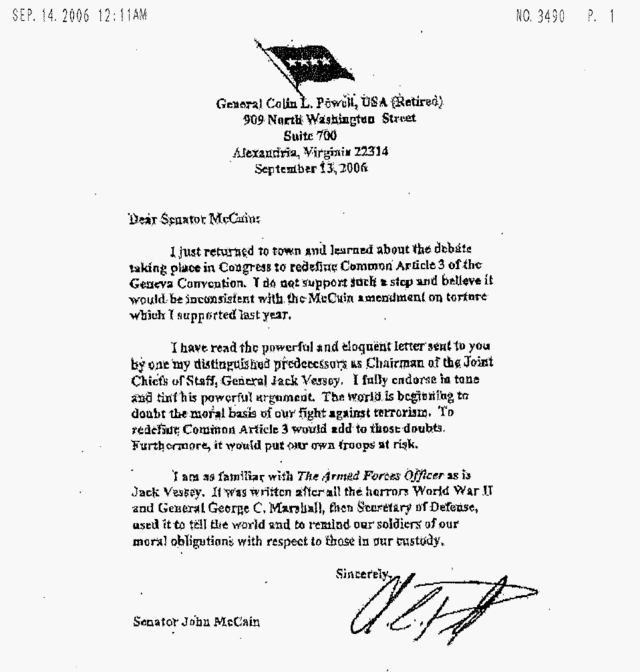
Source: ThinkProgress
Hugues
Cette nouvelle législation vise à établir un système de commissions militaires pour juger les suspectés de terrorisme. Autrement dit un suspect de terrorisme ne sera plus égal devant la loi puisqu'il ne pourra être jugé par un tribunal populaire, et le sera par une sorte de cour martiale.
Selon Colin Powell cette législation "libéralisera la définition de ce qu'est la torture" en amendant le War Crimes Act afin de "permettre l'utilisation de l'hypothermie, de menace de violence sur le détenu et sa famille, des positions infligeant de la contrainte (du stress), le 'debout longtemps', la privation prolongée de sommeil, et possiblement le waterboarding" (forme moderne de la torture par l'eau)
Powell écrit ainsi que "Le monde commence à douter de la base morale de notre combat contre le terrorisme. Redéfinir le Common Article 3 ajouterait à ces doutes. De plus, cela mettrait nos troupes en danger."
La transcription de la lettre:
Dear Senator McCain,
I just returned to town and learned about the debate taking place in Congress to redefine Common Article 3 of the Geneva Convention. I do not support such a step and believe it would be inconsistent with the McCain amendment on torture which I supported last year.
I have read the powerful and eloquent letter sent to you by one my [sic] distinguished predecessors as Chairman of the Joint Chiefs of Staff, General Jack Vessey. I fully endorse in tone and tint his powerful argument. The world is beginning to doubt the moral basis of our fight against terrorism. To redefine Common Article 3 would add to those doubts. Furthermore, it would put our own troops at risk.
I am as familiar with The Armed Forces Officer as is Jack Vessey. It was written after all the horrors of World War II and General George C. Marshall, then Secretary of Defense, used it to tell the world and to remind our soldiers of our moral obligations with respect to those in our custody.
Sincerely,
[Signature]
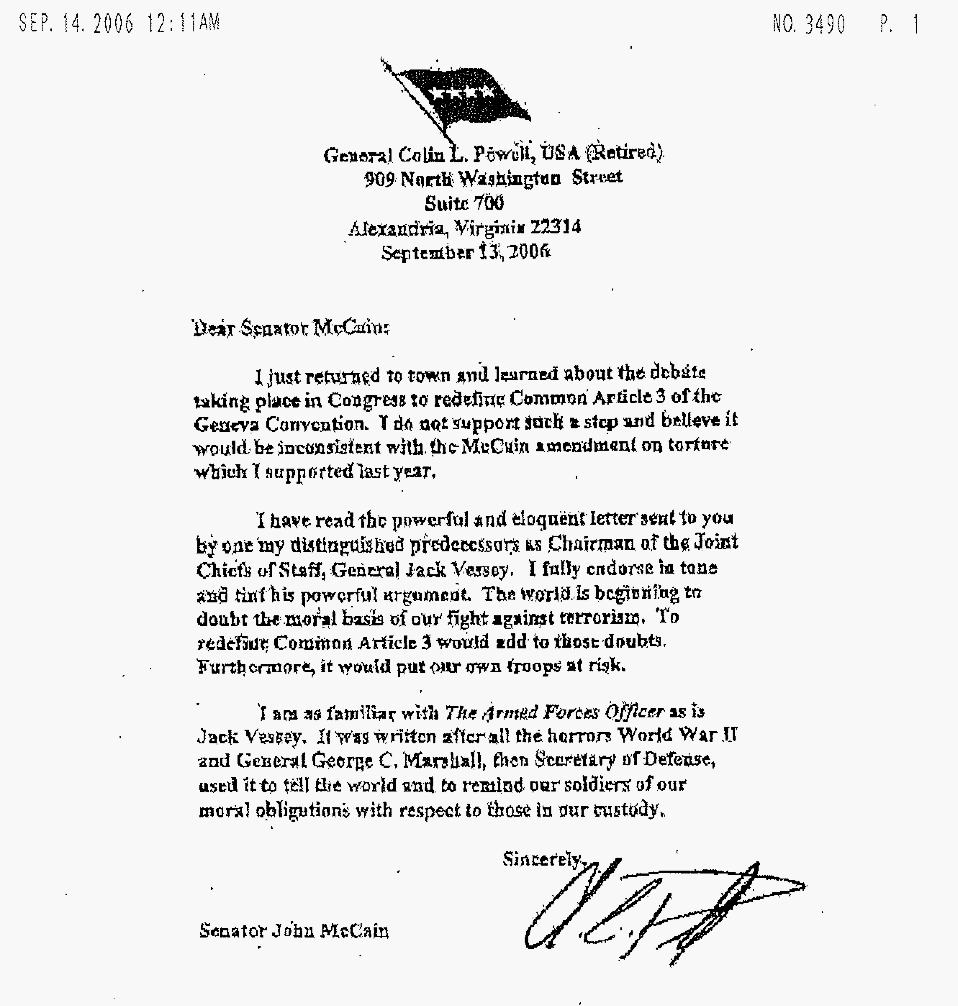
Source: ThinkProgress
Hugues
- Hugues
de Hugues le 14 Sep 2006, 21:55
Ze a écrit:Cool, ils vont reintégrer le supplice de la roue
Certes, mais bon c'était pas tellement l'objet de mon post, plutôt que même Powell, suffisamment fidèle de Bush pour avoir été jusqu'à remettre sa crédibilité en cause par sa fameuse intervention à l'ONU en 2003, n'arrive plus à cautionner la politique de l'administration Bush..
Hugues
- Hugues
de blurfy le 14 Sep 2006, 22:05
bon, j'ai rien compris, mais comme hugues est friand de texte qu'il comprend et les affiche comme si tout le monde les comprenaient, je voulais juste dire ça :
c'est pas ettonant qu'on retourne a des methodes anciennes tellement les meurtriers et assassins qu'on arretent sont juste que presumés .
le public est tellement pour la justice qu'il en protege l'assassin . dailleurs, il n'existe plus d'assassins, le seul portant le chapeau est la société .
alors on libere les presumés et c'est bien normal !
" Un matin, il m'a promis de me raconter une histoire incroyable, et il a disparu."
-

blurfy - Messages: 4611
- Inscription: 09 Avr 2004, 21:34
- Localisation: dans le coin toulousain
de Hugues le 16 Sep 2006, 19:47
(Uhm, je viens de perdre tout ce post, me voici contraint de le réécrire en espérant ne rien oublier en chemin et rester aussi clair.. j'en doute)
Les oppositions de McCain et Powell n'ont pas perturbé Bush dans sa volonté de faire adopter sa législation autorisant des actes assimilés à la torture aux membres de la CIA, envers les personnes soupçonnées de terrorisme.
"Affaiblir les protections de la Convention de Genève, est non seulement non nécessaire, mais donnerait le mauvais exemple, le signal, aux autres pays, avec ce respect moindres des droits humains basiques, qu'ils peuvent à leur tour produire leur propre réinterprétations législatives. Cela met notre personnel militaires et d'autres Américains directement à risque dans cette guerre et dans les futures.", expliquait ainsi McCain.
Intervenant jeudi, Bush a ainsi rejeté la législation proposée par McCain requérant le respect de la Convention de Genève dans les pratiques de détentions des combattants ennemis. Irrité, ce qui transparaissait à travers sa voix et ses gestes, il a insisté sur le fait que la CIA n'avait pas besoin de cette régulation par la Convetion de Genève, mais d'une législations définissant spécifiquement ce qui était banni, afin que les officiers de la CIA ne voient pas peser sur leurs épaules l'incertitude de savoir si il respecte ou non la "floue" Convention de Genève, ainsi que la menace d'accusation de crimes de guerre.
Il a ainsi prévenu les sénateurs républicains qui voudraient s'aventurer à voter la législation McCain qu'il fermera en ce cas le programme d'interrogation de la CIA, dont il prétend qu'il a évité un bon nombre d'attaques terroristes. Pour justifier cette fermeture, il a prétendu qu'aucun membre de la CIA ne voudra plus se risquer à interroger sous une telle législation et que la fermeture, ne serait que clore un programme tué par la législation McCain.
Cet avertissement qui tient de la menace, vise bien évidemment à mettre aux ordres les Sénateurs de son parti, l'électorat risquant de se rebeller face à des Sénateurs qui selon Bush, auront affaibli la sécurité des Etats-Unis. Interrogé deux fois si dans le cas où plutôt que sa propre législation, celle de McCain était adopté, il userait de son veto, Bush s'est refusé à se prononcer.
En revanche, alors que le leader de la majorité (républicaine) de la Chambre des Représentants a accusé les Démocrates d'être plus soucieux de la protection des terroristes que de la protection des Américain, il a désavoué ses propos, probablement soucieux de conserver le soutien de certains Démocrates sur d'autres projets de lois, affirmant : "Je ne l'aurais pas dit de cette manière. Mais je crois qu'il y a une différence d'attitude."
C'est en quelques mots le contenu de ce long et passionnant article du Washington Post, que je vous recommande de consulter pour être au fait de l'évolution de cette grande bataille législative pour la défense des droits humains élémentaires, valeurs comme je l'ai déjà écrit par ailleurs, que les démocraties ne doivent pas perdre en chemin, dans leur lutte contre le terrorisme, sous peine de crédibiliser, aux yeux de populations musulmanes ou arabes, n'ayant aucune sympathie pour les islamistes, ce discours islamiste qui dénonce le mal perpétré par l'Occident.
Hugues
- Hugues
de Hugues le 16 Sep 2006, 20:04
Par ailleurs sur un plan plus anecdotique, le Washington Post indique que la CIA savait dès 2002 que Ben Laden n'avait aucun lien avec l'Irak, et en avait informé le président
http://www.washingtonpost.com/wp-dyn/co ... 01545.html
Cela n'avait pas empêché Bush pourtant de prononcer quelques jours plus tard, le 25 septembre 2002, les mots suivants:
"Al-Qaeda se cache. Saddam ne se cache pas, mais le danger est, est qu'ils travaillent de concert. Le danger est, est qu'al-Qaeda devienne une extension de la folie de Saddam et sa haine et sa capacité à diffuser les armes de destructions massives tout autour du monde... On ne peut distinguer al-Qaeda et Saddam quand on parle de la guerre contre le terrorisme."
A propos de ce gigantesque mensonge justement, pour le moment 38 membres de la chambre des Représentants soutiennent la loi d'impeachment (qui est une loi d'inculpation, de mise en examen, Clinton a été empêché, pourtant il n'a pas été condamné) dénonçant ce mensonge:
http://www.conspiracyplanet.com/channel ... entid=3906
Enfin, lors de sa venue au Nations Unies, le 19 septembre, NYPD, la police de New York a surprenamment décidé, de changer d'avis et de ne pas protéger les Nations Unies en interdisant la marche vers le batiment international. La marche est donc autorisée.
http://www.unitedforpeace.org/
Hugues
http://www.washingtonpost.com/wp-dyn/co ... 01545.html
Cela n'avait pas empêché Bush pourtant de prononcer quelques jours plus tard, le 25 septembre 2002, les mots suivants:
"Al-Qaeda se cache. Saddam ne se cache pas, mais le danger est, est qu'ils travaillent de concert. Le danger est, est qu'al-Qaeda devienne une extension de la folie de Saddam et sa haine et sa capacité à diffuser les armes de destructions massives tout autour du monde... On ne peut distinguer al-Qaeda et Saddam quand on parle de la guerre contre le terrorisme."
A propos de ce gigantesque mensonge justement, pour le moment 38 membres de la chambre des Représentants soutiennent la loi d'impeachment (qui est une loi d'inculpation, de mise en examen, Clinton a été empêché, pourtant il n'a pas été condamné) dénonçant ce mensonge:
http://www.conspiracyplanet.com/channel ... entid=3906
Enfin, lors de sa venue au Nations Unies, le 19 septembre, NYPD, la police de New York a surprenamment décidé, de changer d'avis et de ne pas protéger les Nations Unies en interdisant la marche vers le batiment international. La marche est donc autorisée.
We Won! We're Marching!
When the NYPD told us there would be no marches in the vicinity of the UN that day, we announced that we would march anyway, even if it meant we went to jail. We have just learned that we are being given a permit for a march and rally that morning to call for an end to the war in Iraq.
http://www.unitedforpeace.org/
Hugues
- Hugues
de Madcad le 16 Sep 2006, 20:20
Hugues a écrit:Certes, mais bon c'était pas tellement l'objet de mon post, plutôt que même Powell, suffisamment fidèle de Bush pour avoir été jusqu'à remettre sa crédibilité en cause par sa fameuse intervention à l'ONU en 2003, n'arrive plus à cautionner la politique de l'administration Bush..
Hugues
Dans le cas de Powell, il s'agissait moins de fidélité que d'entubage.
La CIA sous la pression de Cheney et Rumsfeld a commencé à produire des rapports favorisant leur agenda politique, rapports naturellement qui reposaient sur du vent.
Tenet, jusque là allié de Powell chez les modérés, a retourné sa veste et a validé le tout, Dieu sait pourquoi.
Powell n'avait aucune raison de ne pas le croire. Son intervention à l'ONU n'est devenu pitoyable qu'avec le recul.
-

Madcad - Messages: 9062
- Inscription: 28 Fév 2003, 05:25
de sccc le 16 Sep 2006, 20:24
Hugues a écrit:Par ailleurs sur un plan plus anecdotique, le Washington Post indique que la CIA savait dès 2002 que Ben Laden n'avait aucun lien avec l'Irak, et en avait informé le président
http://www.washingtonpost.com/wp-dyn/co ... 01545.html
Cela n'avait pas empêché Bush pourtant de prononcer quelques jours plus tard, le 25 septembre 2002, les mots suivants:
"Al-Qaeda se cache. Saddam ne se cache pas, mais le danger est, est qu'ils travaillent de concert. Le danger est, est qu'al-Qaeda devienne une extension de la folie de Saddam et sa haine et sa capacité à diffuser les armes de destructions massives tout autour du monde... On ne peut distinguer al-Qaeda et Saddam quand on parle de la guerre contre le terrorisme."
A propos de ce gigantesque mensonge justement, pour le moment 38 membres de la chambre des Représentants soutiennent la loi d'impeachment (qui est une loi d'inculpation, de mise en examen, Clinton a été empêché, pourtant il n'a pas été condamné) dénonçant ce mensonge:
http://www.conspiracyplanet.com/channel ... entid=3906
Enfin, lors de sa venue au Nations Unies, le 19 septembre, NYPD, la police de New York a surprenamment décidé, de changer d'avis et de ne pas protéger les Nations Unies en interdisant la marche vers le batiment international. La marche est donc autorisée.We Won! We're Marching!
When the NYPD told us there would be no marches in the vicinity of the UN that day, we announced that we would march anyway, even if it meant we went to jail. We have just learned that we are being given a permit for a march and rally that morning to call for an end to the war in Iraq.
http://www.unitedforpeace.org/
Hugues
Ca me fait penser au démasquage de la sorcière dans Monty Python et le sacré Graal!!!

scc
THE ITALIAN GUY...
"...elles donnent beaucoup de lait vos chèvres mon brave? Les blanches donnent beaucoup de lait...et les noirrres aussi..."
THE ITALIAN GUY...
"...elles donnent beaucoup de lait vos chèvres mon brave? Les blanches donnent beaucoup de lait...et les noirrres aussi..."
-
sccc - Messages: 20255
- Inscription: 22 Fév 2003, 19:32
- Localisation: Belgique
de schumi84f1 le 16 Sep 2006, 21:50
je pense qu'il n'y avait pas que lui qui avait fait ce raccourci
designed by BWT ©
-
schumi84f1 - vettel84f1
- Messages: 37024
- Inscription: 12 Oct 2004, 20:39
- Localisation: APT (84)
de Hugues le 18 Sep 2006, 00:37
Quand beaucoup de par le monde dénonçait que l'invasion illégale qu'a été celle contre l'Irak, était motivée par le pétrôle, ces gens ont été humiliés, y compris par l'Administration américaine qui les a renvoyés dans les cordes, et, quand ils étaient américains, les a accusés d'antipatriotisme
Pourtant aujourd'hui ce n'est pas une source qui par but électoraliste voudrait nuire aux Républicains qui le prétend.
Non, c'est un Républicain.
Donald Rumsfeld lui même dans une émission de radio.
Certes il ne le dit qu'à demi-mot, qu'il était mieux que le pétrole de l'Irak soit entre les mains des USA qu'entre les mains de Saddam Hussein, et il prétexte une question de sécurité (avec l'argent il aurait pu se construire des armes) plutôt qu'une question économique. Mais on s'approche..
Ce qui est amusant, c'est qu'il n'a pas compris visiblement que le prix n'a monté que parce que le Moyen Orient, par l'intervention américaine, est désormais moins sûr qu'il ne l'était avant 2003.
Hugues
Pourtant aujourd'hui ce n'est pas une source qui par but électoraliste voudrait nuire aux Républicains qui le prétend.
Non, c'est un Républicain.
Donald Rumsfeld lui même dans une émission de radio.
Donald Rumsfeld via DefenseLink.mil a écrit:SECRETARY RUMSFELD: The fact of the matter is - if Saddam Hussein were still in power in Iraq, he would be rolling in petrol dollars. Think of the price of oil today. He would have so much money. And he would be seeing the Iranians interested in a nuclear program, he would be seeing the North Koreans developing a nuclear program, and he’d say well why shouldn’t he - and he would. So we’re fortunate that he’s gone.
Certes il ne le dit qu'à demi-mot, qu'il était mieux que le pétrole de l'Irak soit entre les mains des USA qu'entre les mains de Saddam Hussein, et il prétexte une question de sécurité (avec l'argent il aurait pu se construire des armes) plutôt qu'une question économique. Mais on s'approche..
Ce qui est amusant, c'est qu'il n'a pas compris visiblement que le prix n'a monté que parce que le Moyen Orient, par l'intervention américaine, est désormais moins sûr qu'il ne l'était avant 2003.
Hugues
- Hugues
Qui est en ligne
Utilisateurs parcourant ce forum: Aucun utilisateur enregistré et 9 invités
